
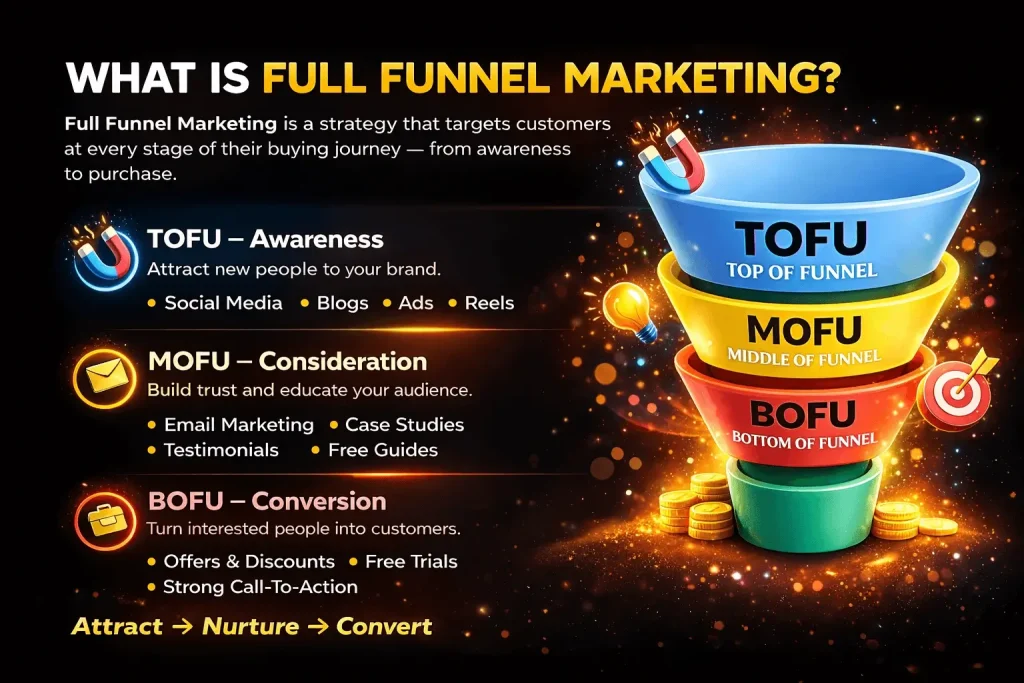
Full Funnel Marketing is the foundation of predictable growth for businesses of all sizes. It’s the difference between running random ads, posting daily content, and hoping for sales versus guiding your audience step by step from first discovering your brand to confidently making a purchase — and even becoming a loyal advocate.
Many businesses fail because they focus only on generating traffic or posting content. They expect followers to become buyers instantly. This rarely works. Funnel Marketing provides a structured system that aligns with how humans make buying decisions, ensuring that every interaction builds trust and leads to conversions.
In this guide, you’ll learn:
Table of Contents
By the end of this guide, you’ll have a complete roadmap to turn your marketing efforts into a predictable growth engine.
What Is Full Funnel Marketing?
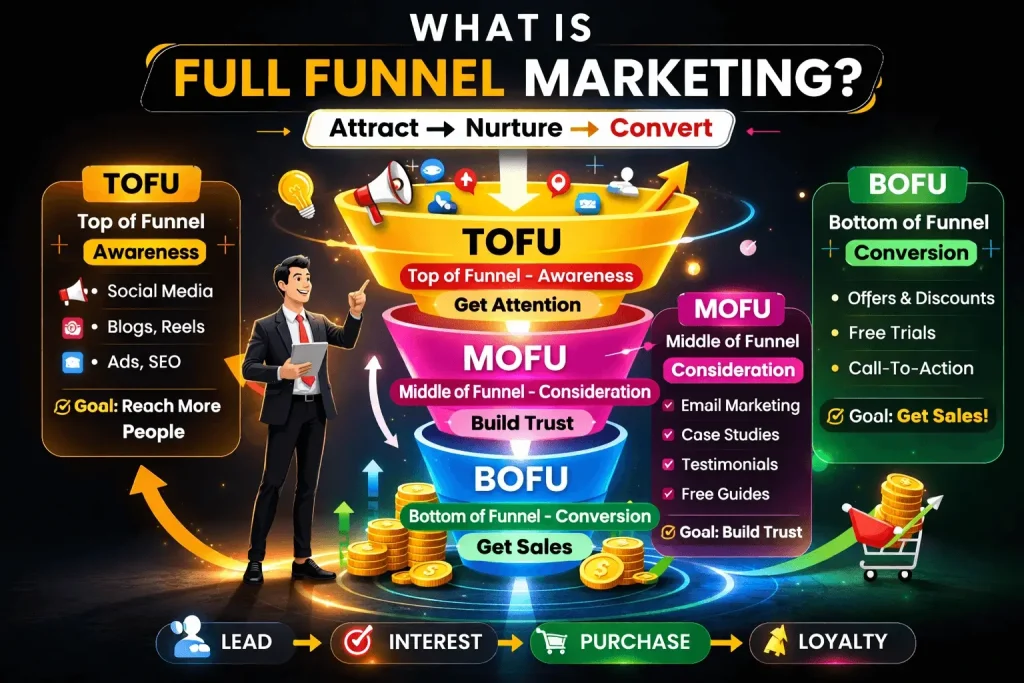
Full Funnel Marketing is a strategy designed around the customer journey. Unlike isolated marketing tactics that push ads, content, or promotions with no plan, Funnel Marketing maps out how people naturally move from first discovering your brand to trusting and eventually buying from you. Think of it like a roadmap. Without a funnel, marketing is like driving in a new city with no GPS — you might reach your destination, but it will be slow, confusing, and inefficient. Full Funnel Marketing is that GPS: it gives every stage a purpose, ensuring prospects flow smoothly toward conversion.
Random Marketing vs Full Funnel Marketing
| Random Marketing | Full Funnel Marketing |
| Posts without strategy | Stage-specific content (TOFU, MOFU, BOFU) |
| Ads with no follow-up | Sequenced campaigns that nurture leads |
| Focus on immediate sales | Focus on guiding prospects naturally |
| Wasted budget & effort | Predictable, measurable growth |
The key idea is simple: people rarely buy from strangers. They move through stages — curiosity, comparison, evaluation, and finally, decision. Funnel Marketing respects this natural buying behaviour.
Why Beginners Struggle Without Full Funnel Marketing?
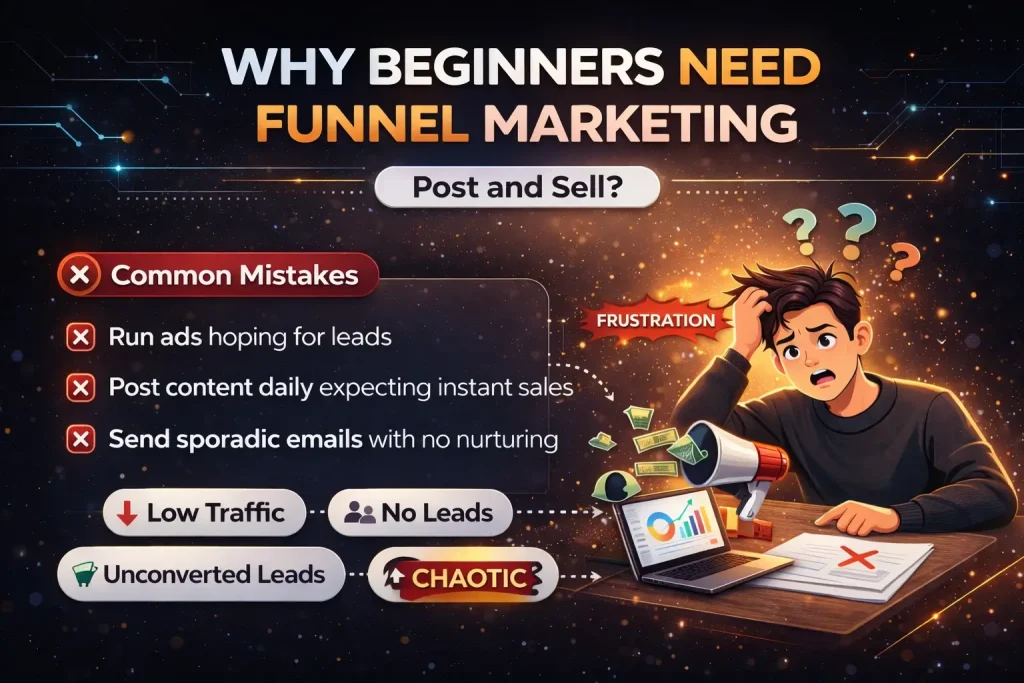
Many beginners approach marketing with the mindset of “post and sell.” They:
- Run ads hoping for leads
- Post content daily expecting instant sales
- Send sporadic emails with no nurturing
The result? Frustration. Leads fluctuate. Conversions remain uncertain. Marketing feels chaotic.
Without Full Funnel Marketing:
- Cold traffic is pushed directly to a sales page
- Leads are collected but not nurtured
- Prospects remain unsure about your brand
Full Funnel Marketing solves this by creating structure. Each stage of the funnel has a purpose: awareness, trust-building, and conversion. Instead of asking strangers to buy immediately, you guide them step by step, reducing friction and building confidence.
Think of it like dating. You wouldn’t propose marriage on the first date. You’d first meet, build rapport, create trust, and then ask for commitment. Funnel Marketing works the same way with prospects.
The Three Stages of Full Funnel Marketing
The strength of Full Funnel Marketing lies in its three-stage system: TOFU, MOFU, and BOFU. Each stage addresses a specific part of the buyer’s journey.
TOFU – Top of Funnel (Awareness Stage)
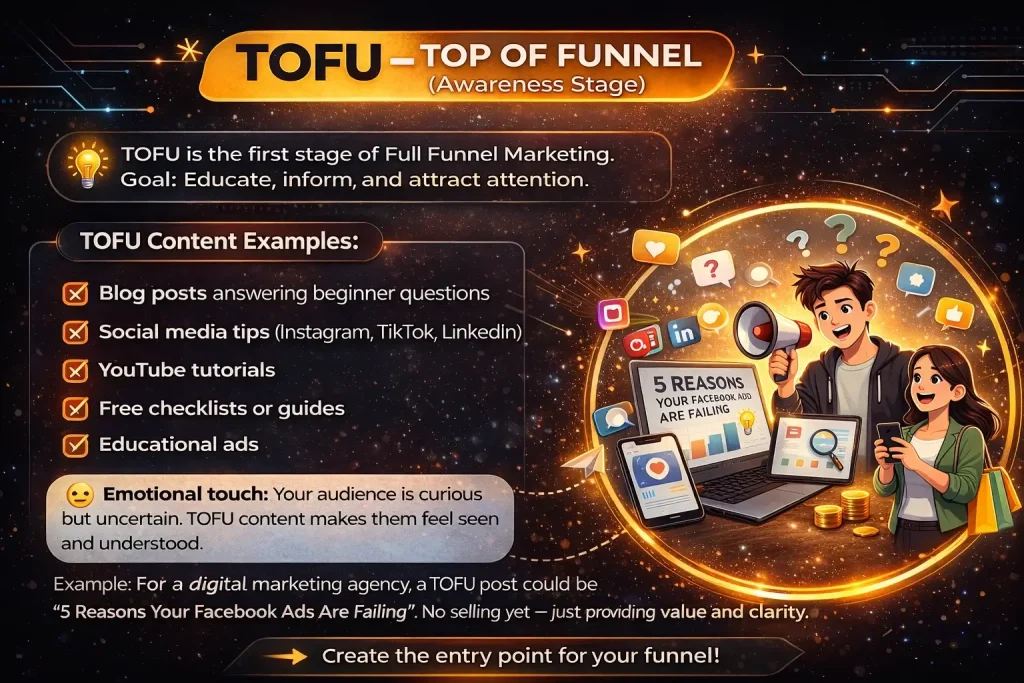
TOFU is the first stage in Full Funnel Marketing. Prospects here don’t know your brand or their problem fully.
Goal: Educate, inform, and attract attention.
TOFU content examples:
- Blog posts answering beginner questions
- Social media tips (Instagram, TikTok, LinkedIn)
- YouTube tutorials
- Free checklists or guides
- Educational ads
Emotional touch: Your audience is curious but uncertain. TOFU content makes them feel seen, understood, and curious to learn more.
Example: For a digital marketing agency, a TOFU post could be “5 Reasons Your Facebook Ads Are Failing”. No selling yet — just providing value and clarity. TOFU creates the entry point for your funnel. Without it, no one enters the journey.
MOFU – Middle of Funnel (Consideration Stage)
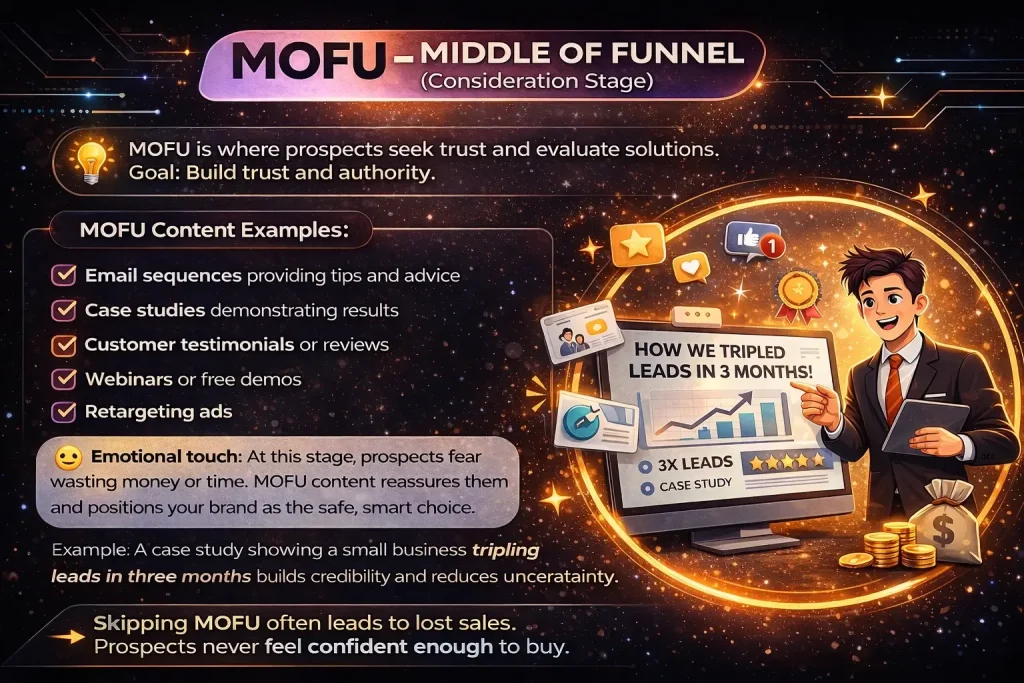
Once awareness is established, prospects enter MOFU, the stage where trust is built.
At MOFU, people ask questions:
- “Is this brand credible?”
- “Will this solution actually work?”
- “How does it compare to others?”
Goal: Build trust and authority.
MOFU content examples:
- Email sequences providing tips and advice
- Case studies demonstrating results
- Customer testimonials or reviews
- Webinars or free demos
- Retargeting ads
Emotional touch: At this stage, prospects fear wasting money or time. MOFU content reassures them and positions your brand as the safe, smart choice.
Example: A case study showing a small business tripling leads in three months builds credibility and reduces uncertainty.
Skipping MOFU often leads to lost sales because prospects never feel confident enough to buy.
BOFU – Bottom of Funnel (Conversion Stage)
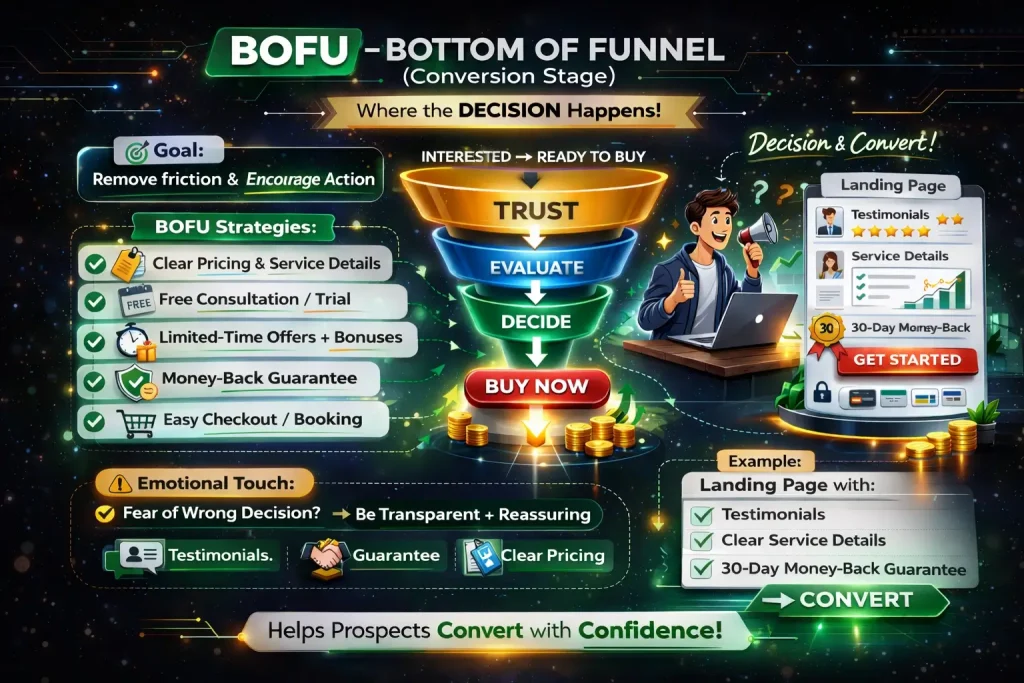
BOFU is where the decision happens. Prospects are interested and somewhat confident, but still need clarity and reassurance.
Goal: Remove friction, simplify the buying process, and encourage action.
BOFU strategies:
- Clear pricing and service breakdown
- Free consultations or trials
- Limited-time offers or bonuses
- Money-back guarantees
- Easy checkout or booking processes
Emotional touch: Fear of making the wrong decision is strong at BOFU. Full Funnel Marketing addresses these fears by being transparent and reassuring.
Example: A landing page with testimonials, clear service details, and a 30-day money-back guarantee helps prospects convert naturally.
Step-by-Step Guide to Implement Full Funnel Marketing
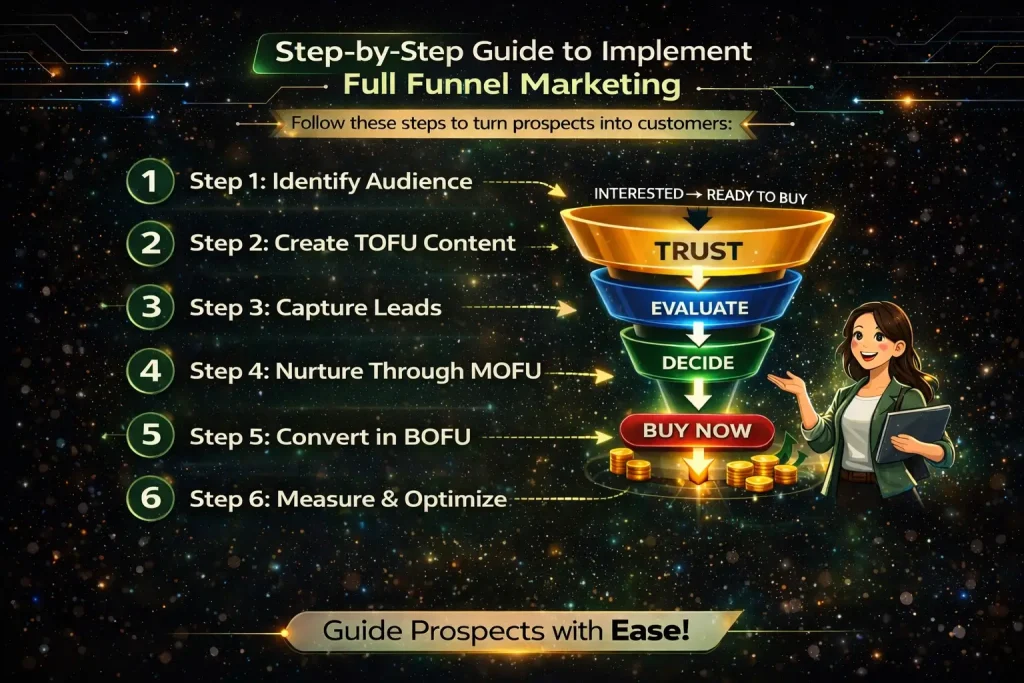
Here’s how beginners can implement Full Funnel Marketing effectively:
Step 1: Identify Your Audience
- Know their problems, goals, fears, and objections
- Understand what motivates them emotionally
Step 2: Create TOFU Content
- Focus on value, education, and problem-solving
- Blog posts, videos, and social media posts attract attention
Step 3: Capture Leads
- Offer a free resource in exchange for an email or contact:
- Ebook, checklist, webinar, consultation
Step 4: Nurture Through MOFU
- Build trust with consistent emails, case studies, testimonials
- Address objections
- Showcase expertise
Step 5: Convert in BOFU
- Present offers clearly and transparently
- Include risk reversal (money-back guarantee, trial period)
- Simplify purchasing process
Step 6: Measure & Optimize
- Track TOFU traffic, MOFU engagement, BOFU conversions
- Adjust campaigns based on results
- Continuously improve your Funnel Marketing system
Common Mistakes to Avoid
- Skipping MOFU and trying to sell too early
- Ignoring nurturing sequences
- Inconsistent messaging across funnel stages
- No follow-up or retargeting campaigns
- Expecting instant results
Full Funnel Marketing works best when each stage is respected and connected.
How digital pirana Applies Full Funnel Marketing?
At digital pirana, Full Funnel Marketing is our growth architecture.
Our process:
- Audience research & psychology: Identify fears, objections, and motivations
- TOFU campaigns: SEO, social media, paid ads to attract the right audience
- MOFU nurturing: Emails, case studies, webinars to build trust
- BOFU optimization: Landing pages, clear offers, risk reversal
- Data & analytics: Measure every stage, optimize campaigns
With Full Funnel Marketing, digital pirana helps businesses turn inconsistent marketing into predictable, scalable growth.
FAQs About Funnel Marketing
1. Is Full Funnel Marketing hard for beginners?
No. TOFU, MOFU, and BOFU give a clear roadmap.
2. Can I use organic traffic only?
Yes. Paid ads accelerate awareness, but organic strategies work well too.
3. How long before I see results?
Focus on long-term growth. Initial traction may appear in weeks, but compounding benefits appear over months.
4. Can small businesses benefit?
Absolutely. Structured funnels help small businesses compete by building trust and authority.
5. What’s the biggest mistake beginners make?
Skipping MOFU and trying to sell too early.
6. How many stages does Full Funnel Marketing have?
Three: TOFU (Awareness), MOFU (Consideration), BOFU (Conversion).
Conclusion
Full Funnel Marketing transforms chaos into clarity. It turns strangers into readers, leads into customers, and customers into loyal advocates.
For beginners, Full Funnel Marketing provides:
- Predictable growth
- Reduced stress
- Better decision-making
- Higher conversions and retention
Stop chasing random tactics. Build a structured system. Guide your audience at every stage — that is the power of Full Funnel Marketing.
Partner with Digital Pirana today to implement a high-performing Funnel Marketing system tailored for your business.